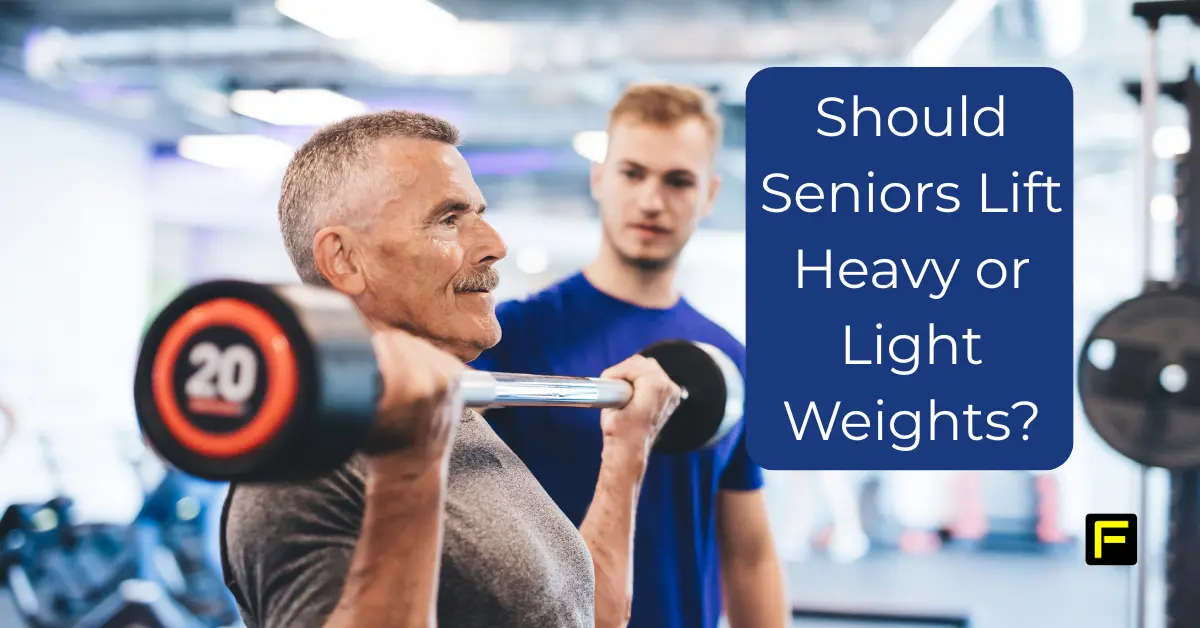
Should seniors lift heavy or light weights? The honest answer is that the question itself is framed wrong, and that framing is what sends most older adults to one counterproductive extreme or the other.

One group avoids anything heavier than five pounds because they are convinced joint damage is inevitable. The other group grabs the heaviest weight on the rack to prove aging has not slowed them down, then wonders why their shoulder or knee is complaining for a week afterward.
After more than 30 years working with older adults, I can tell you that neither extreme produces good results. What works is understanding what the research actually shows about load, rep ranges, and muscle stimulus after 60, and then applying that understanding exercise by exercise rather than applying one blanket rule to every movement in your program.
If the gym itself feels intimidating before you even get to the question of how much to lift, my guide on overcoming your fears of going to the gym for the first time addresses that first.
This article gives you that understanding, along with a practical system for choosing the right load for every exercise you do.
Quick Links
What the Research Says About Load and Muscle Growth
For decades, the conventional wisdom in exercise science held that heavier loads, specifically weights that limited you to 6 to 8 repetitions per set, were required to produce meaningful muscle hypertrophy. Lighter weights were considered appropriate only for warm-ups, rehabilitation, or general conditioning.
That model has been substantially revised by more recent research, and the revision matters enormously for older adults.
A landmark 2016 study led by Dr. Stuart Phillips and Dr. Nicholas Burd at McMaster University compared muscle protein synthesis responses in trained adults using heavy loads at low reps versus lighter loads at high reps, with total training volume equated between groups. The finding was striking: both groups produced equivalent muscle growth, provided the lighter-load group trained close to muscular failure.
A follow-up study published in the Journal of Applied Physiology in 2019 confirmed this finding specifically in older adults, concluding that loads ranging from 30 to 80 percent of one-rep maximum produced similar hypertrophy outcomes when volume was matched and effort was sufficient. The National Institute on Aging echoes this direction in its physical activity guidance, noting that older adults benefit from resistance training at a variety of load levels when performed consistently and with adequate effort.
What this means in practical terms: the load itself is not the primary driver of muscle growth. The effort relative to your capacity is.
A 70-year-old lifting a weight that challenges them to a similar degree to a 30-year-old lifting a heavier weight will produce comparable muscle stimulus, provided both are working close to their limit.
Why This Research Changes Everything for Older Adults
The load-equivalence finding is more significant for older adults than for any other training population, for two reasons.
First, joint tolerance changes with age. Cartilage thins, tendons become less elastic, and the connective tissue around joints accumulates decades of wear. Heavier loads place greater compressive and shear forces on these structures. For a 35-year-old with healthy cartilage and elastic tendons, this is manageable. For a 65-year-old with some arthritis in their knee or a rotator cuff that has been through decades of use, the same load can tip from productive to injurious.
Second, the injury cost is higher. A 30-year-old who strains a rotator cuff from going too heavy recovers in four to six weeks and gets back to training. A 65-year-old with the same injury may require three to four months to recover fully, and that extended detraining period erases months of accumulated strength gains. The asymmetry of injury consequences at older ages makes joint protection a priority, not an option. The American College of Sports Medicine specifically recommends that older adults prioritize moderate loads and controlled movement over maximal effort for this reason.
The research tells us we do not have to sacrifice muscle stimulus to protect joints. We can get both by training at moderate loads with higher reps, performed close to failure.
That is the foundation of effective strength training for adults over 60.
The Case Against Going Too Light
Here is where I want to push back on the other extreme.
Picking up five-pound dumbbells and doing 30 relaxed repetitions of a bicep curl is not strength training. It is going through the motions. The muscle receives no meaningful stimulus, the connective tissue gets no productive load, and the time invested produces almost no physical benefit.
The critical variable in the McMaster research was not just the rep range. It was the effort level. Lighter loads produce equivalent muscle growth only when the set is taken close to muscular failure, meaning the last few reps require genuine effort and the next rep would be impossible or would require a significant compromise in form.
A set of 15 reps where you stop at rep 15 feeling like you could have done 10 more is not training to sufficient effort. A set of 15 reps where rep 14 and 15 required real focus and rep 16 was genuinely not possible is training at sufficient effort.
I see this pattern most often with women who are new to lifting after 60. They pick up the three-pound dumbbells because they do not want to get bulky, they complete every rep without difficulty, and they leave the session wondering why nothing is changing after six weeks. The weight was never the problem. The effort level was.
Going too light, with too little effort, is one of the most common training errors I see in older adults. The weights are safe but the session is essentially wasted.
The FitFab50 Load Selection System
Rather than prescribing a universal rep range, I use a three-tier approach that accounts for the exercise, the joint involvement, and the individual’s training history.

Tier 1: Compound Lower-Body Movements
Squats, hip hinges, leg presses, and similar movements involve the knee and hip joints under load. These joints bear the most age-related wear in most adults over 60.
Recommended load: 12 to 20 reps at moderate weight.
The higher rep range reduces peak compressive force on the knee and hip while still producing adequate muscle stimulus. You should reach near-failure between rep 15 and 20. If you hit 20 reps comfortably with reps to spare, increase the weight at your next session.
Tier 2: Compound Upper-Body Movements
Chest presses, rows, shoulder presses, and pull-down variations involve the shoulder and elbow joints. These tolerate slightly higher loads than lower-body movements in most older adults, as they do not bear bodyweight compressive forces.
Recommended load: 10 to 15 reps at moderate to moderately heavy weight.
You should reach near-failure between rep 10 and 15. Upper-body pressing movements, particularly overhead press variations, require extra caution in adults with any history of rotator cuff issues. When in doubt, stay in the higher end of the rep range.
Tier 3: Isolation Movements
Bicep curls, tricep extensions, lateral raises, and similar single-joint exercises carry lower injury risk and lower joint stress than compound movements.
Recommended load: 12 to 20 reps at light to moderate weight.
These exercises are best used as accessories to your compound work, not as your primary training stimulus. Use them to address weak points or to add targeted volume to smaller muscle groups. Never the heaviest work in your session.
How to Find the Right Weight: The Two-Test Method
Prescription by rep range only works if you have a way to identify whether the weight you have selected is appropriate. Here is the two-part test I teach every new older adult lifter.
The Form Test
Complete your target reps with the weight you have selected. If your form breaks down before you reach your target rep count, the weight is too heavy. Reduce it by 10 to 15 percent and try again. Form breaking down means compensating with other muscle groups, losing your range of motion, or speeding up the movement to use momentum instead of muscle force.
The Effort Test
After completing your target reps with good form, ask yourself honestly: could I have completed 3 or more additional reps? If yes, the weight is too light. Increase it by 5 percent at your next session. The goal is to finish your target reps with 1 to 3 reps left in reserve, not 8 or 10.
These two tests together give you a practical bracket: heavy enough to challenge you, light enough to protect your joints and mechanics.
Using RPE to Monitor Load Over Time
Rate of Perceived Exertion (RPE) is a simple self-reported scale from 1 to 10 that describes how hard a set feels. It is one of the most useful tools for older adults because it accounts for daily variation in energy, recovery, and readiness in a way that fixed weight prescriptions cannot.

For most working sets in a senior strength training program, you want to be operating at an RPE of 7 to 8. This means the set feels hard, the last few reps require real effort, and you estimate you have 2 to 3 reps remaining before failure.
An RPE of 5 or 6 means the set is too easy and the weight should increase. An RPE of 9 or 10 means you are working at or very near failure, which is appropriate occasionally for experienced older lifters but not recommended as a baseline for those new to training after 60.
The advantage of RPE for older adults is that it adjusts for days when recovery is incomplete, sleep was poor, or energy is lower than normal. On those days, your RPE-appropriate load will naturally be lighter, protecting you from pushing through a heavy session on a body that is not ready for it.
Equipment That Supports Smart Load Selection
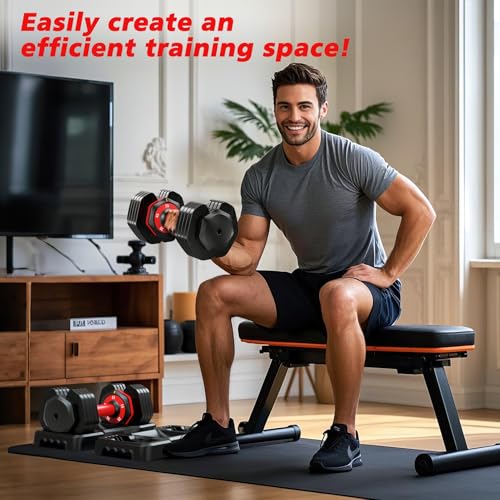
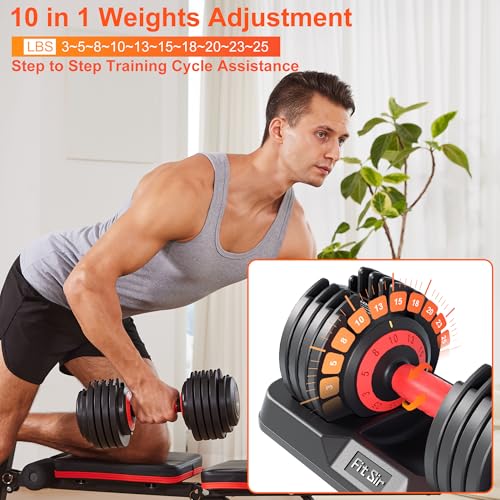
One of the practical challenges for older adults following a load-by-exercise approach is having access to incremental weight increases. Fixed-weight dumbbells require you to jump from, say, 15 pounds to 20 pounds, a 33 percent increase that can be too large a step for many older adults at upper rep ranges.

Adjustable dumbbells solve this by allowing 2 to 2.5 pound increments, which is much more appropriate for the fine-tuned progression that effective older adult training requires. See my best adjustable dumbbells for seniors guide for options across every budget.
Resistance bands are a useful complement, particularly for upper-body isolation work and for days when joint comfort makes standard loading feel rough. They provide accommodating resistance, meaning the resistance increases through the range of motion as the band stretches, which reduces stress at the joint’s most vulnerable position. If you have arthritis or sensitive joints, my guide to resistance bands for women over 50 with arthritis covers the specific band types and tension levels that work best for aging joints.
Putting It Together: A Practical Example Session
Here is what the load-selection approach looks like applied to a simple three-movement session.

Goblet Squat (Tier 1, lower body compound) Target: 3 sets of 15 to 18 reps. Weight should bring you to near-failure by rep 16 to 18. If you reach 18 easily with reps to spare, increase the weight next session.
Dumbbell Row (Tier 2, upper body compound) Target: 3 sets of 12 to 14 reps per side. Weight should require genuine effort for the final 2 to 3 reps. Form should stay clean throughout.
Bicep Curl (Tier 3, isolation) Target: 2 sets of 15 reps. These should be challenging but controlled. Slow the lowering phase to 3 seconds to increase stimulus without increasing load.
Total working sets: 8. Total session time with warm-up: 35 to 40 minutes. Effective, joint-friendly, and appropriately challenging.
What you eat in the hour after this session matters as much as the session itself. See my post-workout snacks guide for the protein and carb combinations that best support muscle recovery in older adults.
For a full 12-week structure built on this approach, my beginner strength training roadmap for adults over 60 walks through progression week by week. If you are returning to training after a break rather than starting fresh, my guide on how to safely return to exercise after a long hiatus covers how to recalibrate your loads after time away.
If joint pain is influencing your load choices, my guide to low-impact exercises for seniors with bad knees covers joint-specific modifications that let you keep training without aggravating problem areas.

The Bottom Line
Should seniors lift heavy or light weights? Neither extreme, applied universally, produces good results.
Heavy loads across every exercise expose aging joints to unnecessary risk. Very light loads with insufficient effort produce no meaningful training stimulus. The research points clearly to a middle path: moderate loads, higher rep ranges than younger adults typically use, and effort levels close to muscular failure.
The tier system gives you a framework to apply this by exercise. The two-test method gives you a way to dial in the right weight on any given day. RPE gives you a self-regulation tool that adjusts for your body’s daily readiness.
Pick the right load for each exercise. Work close to your limit. Protect your joints by staying in appropriate rep ranges. Progress the load by small increments when the work feels manageable.
That is how older adults build real, lasting strength without paying for it with their joints.
Medical Disclaimer: This content is for educational and informational purposes only. It is not intended as a substitute for professional medical advice, diagnosis, or treatment. Consult your physician before beginning any new exercise program, especially if you have existing health conditions or take prescription medications.
About the author

Rick Huey is a fitness writer who has dedicated his life to living an active lifestyle. With more than 30 years of experience in the fitness industry, Rick is a respected contributor for FitFab50.com, where he shares his wealth of knowledge with a wide audience. His dedication to promoting the benefits of living an active lifestyle has inspired many people to pursue their own fitness journeys with enthusiasm and dedication.
Last update on 2026-04-02 / Affiliate links / Images from Amazon Product Advertising API