
You eat the same way you did at 40. You move about the same. Yet the scale creeps up, and the extra weight settles right around your middle.
That is not a willpower problem. After menopause, hormonal changes shift fat storage away from your hips and thighs toward your belly. The good news? A smart walking plan for fat loss after 50 works with that shift instead of fighting it.

- FRESH FOAM MIDSOLE – Plush Fresh Foam cushioning absorbs impact and delivers a soft, comfortable ride for road runs and everyday wear
- ULTRA HEEL DESIGN – Targeted heel support provides a secure, locked-in fit that keeps your foot stable and comfortable throughout your run
- NDURANCE OUTSOLE – Durable NDurance rubber outsole technology handles road miles and daily wear while maintaining reliable traction on multiple surfaces
You do not need a gym membership, a trainer at your elbow, or knees that love running. You need supportive shoes, about 30 minutes most days, and a plan that progresses each week.
That is exactly what you will get here. I am Claudia Faucher, a certified personal trainer with more than 15 years of coaching women over 50. Below is the same 4-week walking program I give my clients, built on research and real results.
Here is what we will cover:
- Why walking burns stubborn midlife fat, including the deep belly fat called visceral fat
- How many steps a day actually matter after 50
- A week-by-week walking schedule you can start tomorrow
- Four techniques that turn an ordinary walk into a fat-burning workout
- How to protect your muscle while the fat comes off
Quik Links
Key Facts: Walking for Weight Loss Over 50
- Weekly target: The CDC recommends at least 150 minutes of moderate activity, such as brisk walking, each week. Add 2 days of muscle strengthening.
- Daily steps: A 2022 Lancet Public Health analysis pooled 15 studies and 47,471 adults. For adults 60 and older, mortality risk kept falling until about 6,000 to 8,000 steps a day.
- Brisk pace: Roughly 100 steps per minute marks moderate intensity. For adults 61 to 85, researchers found 105 steps per minute fits better.
- Belly fat: In a University of Michigan study, postmenopausal women trimmed waist size about 3 percent. Slow and fast walkers saw similar results over 30 weeks.
- Intervals: Japanese interval walking raised aerobic capacity 14 percent in 679 adults averaging age 65.
- After meals: Three 15-minute walks after meals matched one 45-minute walk for blood sugar control in adults near 60.
- Protein: Experts recommend 1.0 to 1.2 grams of protein per kilogram daily for older adults. Active adults need more.
Quotable takeaway: After 50, the total energy you burn walking matters more for visceral fat than how fast you walk. Consistency beats speed.

- Designed for yoga. Light support
- Butterluxe collection features extremely soft and ultra stretchy, engineered for luxurious comfort
- Built-in removable pads
Why Walking Burns Stubborn Fat After 50
Walking is not a “lesser” workout. For women in midlife, it may be the most sustainable fat-burning tool you own. That is why walking for weight loss over 50 works when crash diets and boot camps fail.
Menopause Moves Fat to Your Middle
Before menopause, estrogen tends to park fat on your hips and thighs. When estrogen drops, more fat collects around your abdomen instead.
Some of that is the soft, pinchable fat under your skin. The more concerning kind is visceral fat, which wraps around your organs. It is linked to heart disease, type 2 diabetes, and insulin resistance.
You cannot spot-reduce either type with crunches. Walking to lose belly fat after menopause works by lowering your overall body fat and improving body composition.
Visceral Fat Responds to Total Effort, Not Speed
Here is the part that surprises most of my clients. In a University of Michigan study, postmenopausal women aged 50 to 70 walked 3 miles, 4 days a week.
One group walked about 3.4 miles per hour. The other walked about 4.1 miles per hour. After 30 weeks, waist circumference, a stand-in for visceral fat, dropped about 3 percent in both groups.
The researchers concluded that visceral fat responds to how much energy you burn, not how fast you go. Women who stayed all 30 weeks lost about 5.7 percent of their body fat.
That same paper pointed to another study of 168 overweight postmenopausal women. Women who walked more than 195 minutes a week lost the most body fat. Those under 135 minutes lost very little.
Walking Protects Your Joints and Your Hormones
Running and high-intensity classes can leave a 55-year-old body sore for days. Walking is low impact, so you recover fast and can show up again tomorrow.
That matters more than any single workout. Fat loss after 50 is built on what you repeat, week after week.
Cranky knees? My guide to low impact exercises for seniors with bad knees pairs well with this plan. And if you want the deeper science on midsection fat, read does walking get rid of belly fat?
It Fights Inflammation, Too
A 2023 randomized trial followed women aged 68 to 72 with obesity. After 12 weeks of moderate walking, they lowered weight, BMI, and body fat percentage.
Their blood markers of vascular inflammation dropped as well. That is a win for your heart, not just your waistband.
It Calms Your Stress Response
Walking is gentle, low-impact cardio that most women find calming rather than draining. Many of my clients also sleep better once they walk daily.
That matters, because poor sleep and chronic stress make menopause weight gain harder to fight. If stress eating is your weak spot, check out these foods that raise cortisol levels.
Your 4-Week Walking Plan for Fat Loss After 50
This plan climbs from about 125 weekly minutes in Week 1 to 180 or more in Week 4. Each week adds one new tool, so your body adapts without getting beat up.
Before you start, wear a step counter or phone for 3 normal days. Your average is your baseline. In one large analysis, adults over 60 averaged about 5,600 steps a day. So do not be discouraged by your number.
How to Know You Are Walking “Briskly”
Brisk walking means about 100 to 105 steps per minute. That keeps your heart rate in a moderate zone. Count your steps for 15 seconds and multiply by 4.
No counter? Use the talk test. You should be able to talk in short sentences, but not sing. On a 1 to 10 effort scale, aim for a 5 or 6. Push harder with pumping arms, and you are power walking.
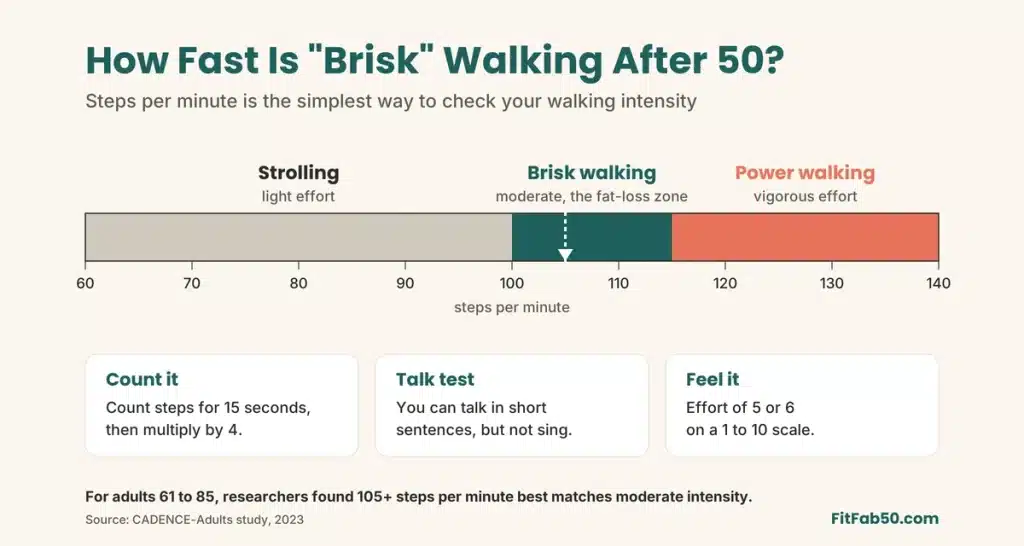
Brisk walking starts around 100 steps per minute. After 60, aim for 105 or more.
Your Everyday Steps Count, Too
The steps you take outside your workout add up. Researchers call this NEAT, short for non-exercise activity thermogenesis.
Park at the far end of the lot, take the stairs, and pace during phone calls. These small moves can add a few thousand steps and boost your daily calorie burn.
The Weekly Schedule
| Week | Focus | Walks per Week | Session Length | Extras | Approx. Weekly Minutes |
|---|---|---|---|---|---|
| 1 | Build the habit | 5 | 20 to 25 min, easy to brisk | 10-min walk after dinner | 125 |
| 2 | Find your brisk pace | 5 | 30 min at 100+ steps/min | 1 hill or incline walk; walk after 2 meals | 150 |
| 3 | Add intervals | 5 | 3 interval walks (30 min) + 2 steady walks (35 to 40 min) | 2 short strength sessions | 170 |
| 4 | Burn phase | 5 to 6 | 3 interval walks + 1 long walk (45 to 60 min) + 1 incline or weighted walk | 2 strength sessions | 180 to 200 |
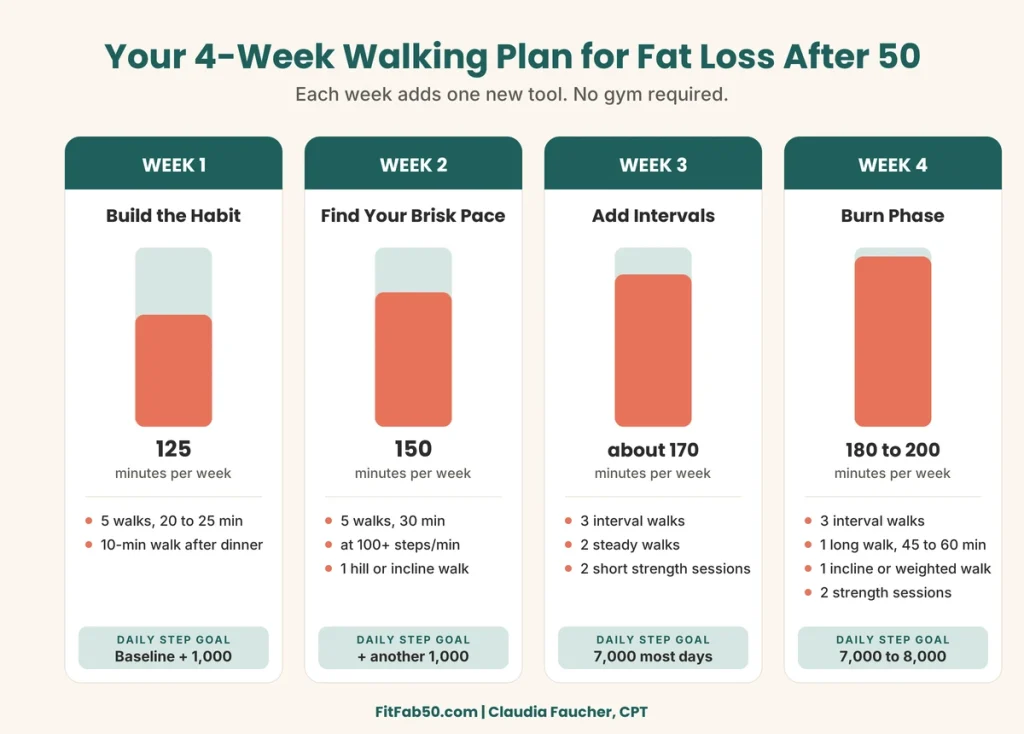
Your 4-week walking plan at a glance. Save it to your phone or print it for the fridge.
Week 1: Build the Habit
Walk 5 days at a comfortable pace that leaves you slightly warm. Start easy for 5 minutes, then pick up the pace for the middle stretch.
After dinner, take a 10-minute stroll around the block. That one small walk helps blunt your evening blood sugar spike.
Step goal: Add 1,000 steps to your daily baseline.
Week 2: Find Your Brisk Pace
Now every main walk lasts 30 minutes at a true brisk pace. That gets you to the CDC’s 150 weekly minutes.
Replace one walk with a hilly route or a treadmill set to a 3 to 5 percent incline. Inclines raise your effort without adding impact.
Step goal: Add another 1,000 steps. Many women land between 6,000 and 7,000 here.
Week 3: Add Intervals
Three days a week, switch to interval walking. You will alternate 3 minutes fast with 3 minutes slow, five times (instructions below).
On two other days, take a steady 35 to 40 minute walk. Add two short strength sessions using your own body weight or a resistance band.
Step goal: Reach 7,000 steps on most days.
Week 4: Burn Phase
Keep your 3 interval days. Add one weekend walk of 45 to 60 minutes. Choose a pace you could hold all morning.
Make one walk an incline or weighted walk (see rucking below). Keep your two strength days.
Step goal: 7,000 to 8,000 steps. That lands right in the range linked to the biggest health payoff after 60.
What Happens After Week 4?
Repeat Week 4 for another month, then keep nudging one thing at a time. Lengthen your long walk, add a hill, or add a fifth interval round.
One of my clients, Linda, started this plan at 61 with a baseline of 3,800 steps. She felt silly walking around the block after dinner. Twelve weeks later, she had dropped two inches from her waist and her jeans buttoned without a fight.
Linda did not walk faster than anyone else. She just did not quit. That is the whole secret.
4 Techniques That Turn a Walk Into a Fat-Burning Workout
Steady walking builds your base. These four techniques make each minute count more.
1. Japanese Interval Walking
You may have seen “Japanese walking” all over social media this year. Its formal name is interval walking training. Researchers at Shinshu University in Japan have studied it for nearly 20 years.
The method is simple:
- Warm up with 3 to 5 minutes of easy walking.
- Walk fast for 3 minutes, at about a 7 out of 10 effort.
- Walk slowly for 3 minutes, at about a 4 out of 10.
- Repeat the fast and slow pair 5 times, for 30 minutes total.
- Cool down for a few minutes.
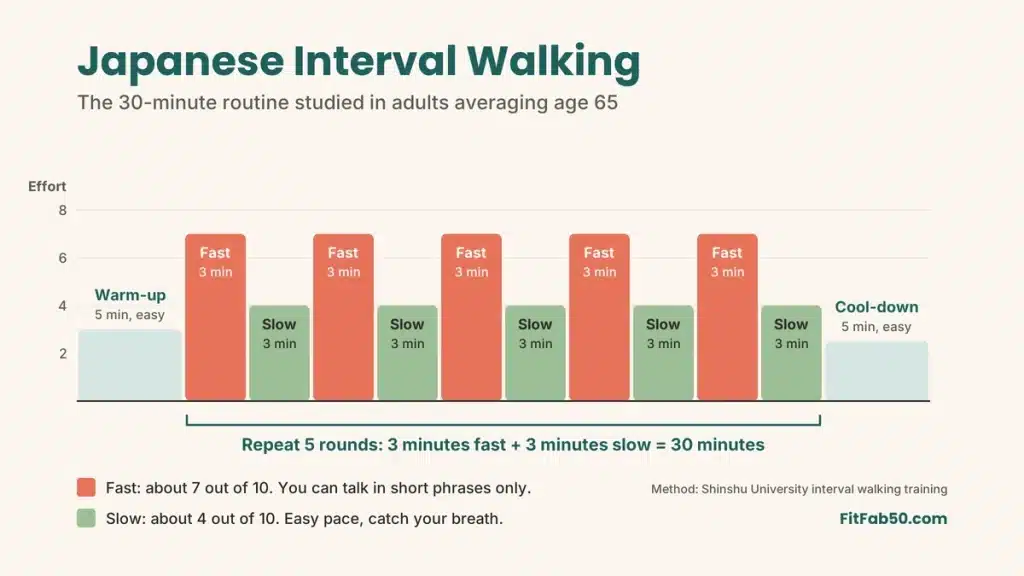
One interval session: 5 rounds of fast and slow, bookended by an easy warm-up and cool-down.
In a study of 679 adults averaging age 65, five months of interval walking raised aerobic capacity about 14 percent. A combined score of lifestyle disease risk dropped 17 percent. That makes interval walking for women over 50 a joint-friendly way to train harder.
Why does that matter for fat? In one study of postmenopausal women, a 10 percent fitness gain doubled visceral fat loss. Better cardiovascular fitness helps your body burn fat more efficiently.
2. Post-Meal Walks
A George Washington University study had adults near age 60 walk 15 minutes after each meal. Those three short walks controlled 24-hour blood sugar as well as one 45-minute walk.
The after-dinner walk worked best. Dinner is usually your biggest meal, and that blood sugar spike can stretch into the night.
No time for 15 minutes? A 2022 analysis of seven studies found even 2 to 5 minutes of walking after eating helped. Steadier blood sugar supports better insulin sensitivity, which matters more after menopause.
This post-meal walk for blood sugar is the easiest habit in this whole plan.
3. Incline Walking
Walking uphill raises your heart rate and works your glutes and hamstrings harder. It does all that without the pounding of running.
Outdoors, find a hill and walk it in repeats. Indoors, a treadmill at a 3 to 8 percent incline does the job. Shopping? My reviews of treadmills for bad knees and quiet treadmills for apartments compare incline ranges.
4. Rucking (Weighted Walking)
Rucking means walking with a weighted backpack. The extra load raises your calorie burn and gently loads your bones.
Start with just 5 to 10 pounds, high on your back, for 20 minutes. Skip ankle weights, which can strain your knees and hips. My rucking workout plan walks you through it step by step.
Weather Out? Walk Indoors
Rain, ice, and humidity are not excuses to skip. A compact walking pad slides under a couch and lets you rack up steps during a TV show.

I rounded up walking pad treadmills for women over 50 that fit small spaces and tight budgets.
Protect Your Muscle While the Fat Comes Off
Here is my honest trainer warning. If you lose weight by walking and eating less, some of that loss can be muscle. After 50, you cannot afford to give muscle away.
Muscle keeps your metabolism humming, steadies your balance, and protects your bones. Age-related muscle loss, called sarcopenia, speeds up after 50. Walking alone will not build much lean muscle mass. These two habits fill the gap.
Add Two Short Strength Sessions
The CDC asks older adults for muscle-strengthening work on at least 2 days a week. You can do it in your living room in 15 to 20 minutes.
Try this simple circuit, 2 or 3 rounds:
- Sit-to-stand squats from a chair: 10 reps
- Wall or countertop push-ups: 10 reps
- Glute bridges on the floor: 12 reps
- Resistance band rows: 12 reps
- Standing calf raises holding a counter: 15 reps
If you are new to lifting, start with my roadmap on how to start strength training at 60. Wondering if it is too late? It is not. Read can you build muscle after menopause for the research.
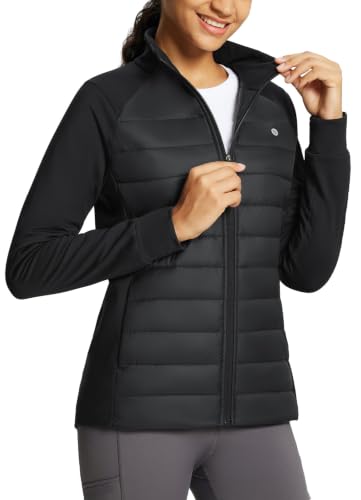
- Premium Cotton Fabric: Experience winter warmth redefined with our premium cotton thermal fabric—ultra-breathable, lightweight yet insulating, and won’t lose shape or get lumpy. Stay comfortably warm without sacrificing style.
- 【Move with Ease】Both sides and back of the jacket are made of spandex fabric, which has excellent stretch keeps you moving freely.
- 【Water-resistant & Stand Collar】Featuring a water-resistant fabric, these jackets provide full-body protection from the elements and the stand collar traps heat, blocks cold, keeping your neck warm.
Eat Enough Protein
Older bodies get less muscle-building bang from each bite of protein. An expert group called PROT-AGE recommends 1.0 to 1.2 grams per kilogram of body weight daily.
If you exercise regularly, they suggest at least 1.2 grams per kilogram. For a 160-pound woman, that is roughly 87 grams of protein a day.
Spread it across your meals instead of loading it all at dinner. Plug your numbers into my free Protein Calculator Pro to find your personal target.
If you struggle to hit your number with food, a quality powder helps. Here is my guide to the best protein powder for women over 50.
Mind Your Calories, Gently
Walking helps, but you cannot out-walk a big calorie surplus. Use my TDEE calculator to estimate your daily burn.
Aim for a small, steady deficit, not a crash diet. In one study, obese postmenopausal women combined walking with a modest daily deficit of 250 to 350 calories. They cut visceral fat by 17 percent and kept their lean muscle.
Want the full picture of losing weight without medication? Read how to lose weight without GLP-1.
The Only Gear You Really Need
No gym required means no gym fees. Still, three items make this plan safer and more comfortable.
Supportive Walking Shoes
Your shoes matter more than anything else you buy. Look for a firm heel counter, a cushioned midsole, and a roomy toe box.
Replace them every 300 to 500 miles, or when the soles look worn. Sore knees or heels? See my picks for shoes for knee pain for women over 50 and shoes for heel pain and walking all day. Balance a concern? Start with walking shoes for seniors with balance problems.

A Step Counter or Fitness Tracker
What gets measured gets done. A simple wrist tracker shows steps, minutes, and heart rate at a glance.
I tested several in my review of the best heart monitor bracelet for over 50.
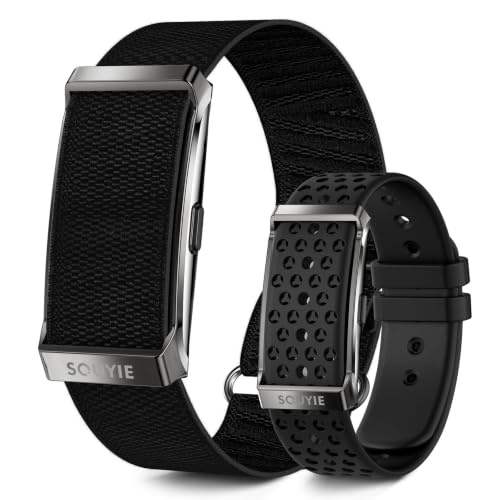
- 【24/7 Continuous Health Tracking】Experience 24/7 continuous health tracking with SOUYIE fitness tracker. Advanced sensors…
- 【All-Day Activity Tracking & 170+ Sports Modes】Maximize every workout with 170+ sports modes and 24/7 activity tracking…
- 【Day and Night Sleep Tracking】Experience 24/7 sleep tracking with our newly upgraded health watch. Monitor your nighttime…
Compression Socks (Optional)
If your legs feel heavy or swollen after longer walks, compression socks can help with comfort. My compression socks buyer’s guide covers sizing and pressure levels.
Claudia’s Pro Tips for Walking After 50
👟 Shorten your stride, quicken your steps. Overstriding jars your knees. Faster, shorter steps raise your pace safely.
💪 Swing your arms from the shoulder. Bend your elbows to about 90 degrees. Your arms help drive your pace and burn a few extra calories.
🍽️ Walk within an hour of dinner. It is the single easiest fat-loss habit in this plan.
📅 Schedule walks like appointments. Put them on your calendar. My clients who do this skip far fewer walks.
👯 Find a walking buddy. Accountability makes it easier to show up on a cold morning.
💧 Hydrate before you feel thirsty. Thirst signals weaken with age, so sip water before and after each walk.
🧘 Stretch after, not before. Warm up by walking easy, then stretch once you finish. Try my 7 stretches you should do every day.
6 Walking Mistakes That Stall Fat Loss After 50
I see these over and over with new clients. Fix them, and the plan works much faster.
- Strolling instead of walking. Window-shopping pace feels nice, but it rarely reaches moderate intensity. Check your steps per minute at least once a week.
- Doing the same walk forever. Your body adapts in a few weeks. Add hills, intervals, or time to keep progressing.
- Eating back every step. A 30-minute walk burns far less than a muffin and latte. Track your food honestly for a week or two.
- Skipping strength work. Walking without strength training can cost you muscle. Keep your two short sessions every week.
- Chasing 10,000 steps on day one. Jumping too fast invites shin splints and sore feet. Build by about 1,000 steps a week. If your shins ache, read my tips on how to prevent shin splints.
- Weighing yourself every morning. Water shifts can hide real fat loss. Measure your waist every two weeks to track body composition instead.
Frequently Asked Questions
Can you lose belly fat just by walking after 50?
Yes, walking can reduce belly fat after 50, including visceral fat. Studies of postmenopausal women show waist size shrinks with regular walking. Results come faster when you add strength training and a modest calorie deficit.
How many steps a day should a woman over 50 walk to lose weight?
Aim to build toward 7,000 to 8,000 steps a day. A 2022 analysis found longevity benefits level off near 6,000 to 8,000 steps after age 60. For how many steps a day to lose weight after 50, your total weekly walking time matters most.
How long does it take to see results from walking?
Most women notice better energy and sleep within 2 to 3 weeks. Visible changes in your waist usually take 8 to 12 weeks. In one study, fat loss became clearer between weeks 15 and 30.
Is it better to walk fast or walk longer?
For visceral fat, total time and energy burned matter more than speed. Research on postmenopausal women found similar waist reductions at slow and fast paces. Walk at a brisk pace you can sustain, and add intervals for fitness.
What is the best time of day to walk for fat loss?
The best time is the time you will actually stick with. That said, a short walk after dinner gives an extra blood sugar benefit. It is a great second walk on busy days.
Is walking enough exercise for women over 50?
Walking covers your aerobic needs, but not your whole routine. The CDC also recommends muscle-strengthening work at least 2 days a week. Adults 65 and older should add balance exercises, too.
Can I do this walking plan with bad knees?
Usually, yes. Walking is low impact, and flat routes or a cushioned treadmill reduce strain further. Skip steep hills at first, wear supportive shoes, and check with your doctor if pain lingers.
Your Next Step Starts Today
You do not need to overhaul your life to lose fat after 50. You need to lace up your shoes and walk a little more this week than last.
Start with Week 1 tomorrow. Take that 10-minute walk after dinner tonight. Then let the plan do its work, one brisk step at a time.
Your body has changed, but it has not stopped responding. Give it consistent movement, enough protein, and a little patience. I promise it will show up for you.
How I Built This Plan
I based this plan on public health guidelines and peer-reviewed studies of adults over 50, especially postmenopausal women. I then shaped it around what I have seen work with my own clients over 15+ years of coaching. Every statistic links to its original source below.
Medical Disclaimer
This article is for general education, not medical advice. I am a certified personal trainer, not a physician. Talk with your doctor before starting a new exercise program. This matters most if you have heart disease, diabetes, or joint problems, or take blood sugar or blood pressure medication.
Affiliate Disclosure: FitFab50 participates in affiliate programs, including programs from major online retailers. I may earn a commission on qualifying purchases from this page, at no extra cost to you. See our full affiliate disclosure.
Sources
- Physical activity guidelines for older adults, CDC
- Daily steps and all-cause mortality: a meta-analysis of 15 international cohorts, Lancet Public Health, 2022
- Effects of Walking Speed on Total and Regional Body Fat in Healthy Postmenopausal Women, Nutrients, 2022
- Reductions in visceral fat during weight loss and walking are associated with improvements in VO2max, obese postmenopausal women study
- Moderate intensity walking exercises reduce BMI and vascular inflammatory factors in postmenopausal women with obesity, Scientific Reports, 2023
- Interval walking training overview and brief walking bursts study summary
- Post-meal walking and blood sugar in older adults, Diabetes Care study coverage
- Just 2 minutes of walking after eating can help blood sugar, Sports Medicine meta-analysis coverage
- Cadence and relative intensity in 61 to 85-year-olds: the CADENCE-Adults study, 2023
- PROT-AGE Study Group protein recommendations for older people, 2013
- Menopause belly and how to address it, Breastcancer.org

Claudia Faucher is a fitness and lifestyle blogger who shares practical tips for women over 50 on staying active, stylish, and confident. As the creator of FitFab50.com and Beyond59.com, she covers topics like workout gear, beauty trends, and wellness routines. Claudia is passionate about helping others live their best life at any age.
Last update on 2026-10-22 / Affiliate links / Images from Amazon Product Advertising API